
OZA V2: Migrations Underway, Liquidity Locked, and New International Outlooks!
OZA V2 continues its relaunch: secure migrations underway, 12.48% of liquidity locked, discussions with recognized CEXs, and a Cointribune investigation.
Read more


While Bitcoin and the majority of altcoins are going through a difficult period, attention is primarily turning toward the United States. Yet a major transformation is also underway in Europe: the reorganization of centralized platforms and the shift of part of cryptocurrencies toward self-custody.
What if this crisis ultimately marked the return to the true foundations of Web3?
At Ozapay, we are closely watching this evolution, while our OZA V2 migration continues, accompanied by a renewed commitment from certain investors and new technological advances.
For several weeks, crypto markets have been undergoing a significant correction.
Bitcoin is facing selling pressure, while many altcoins are recording particularly steep declines.
Analyses generally point to American economic uncertainties, monetary policy, the liquidation of speculative positions, and capital outflows from Bitcoin ETFs.
These factors are unquestionably important.
According to Glassnode, in its report dated November 11, 2026, the global stablecoin supply contracted by approximately $14.2 billion in thirty days.
At the same time, American Bitcoin ETFs recorded approximately $1.6 billion in net outflows over twenty trading sessions.
These figures reflect a contraction in the liquidity available to support the markets.
But attributing all of the industry's difficulties to the United States alone would be an incomplete reading.
Because while investors watch Washington, Europe is profoundly transforming its own cryptoasset market.
The entry into force of the new European requirements linked to the MiCA regulation has profoundly changed how cryptocurrency platforms operate.
Since July 1, 2026, providers wishing to continue offering cryptoasset services in the European Union must hold the necessary authorizations.
This development is aimed in particular at strengthening user protection and better overseeing intermediaries.
But its consequences for the organization of the market are considerable.
Binance, one of the largest global platforms, provides a particularly telling example.
Lacking the MiCA authorization required to continue the services concerned, the platform has begun a gradual reduction of its activities for several categories of European users.
In France, the affected accounts must be closed as of December 31, 2026.
Similar notifications have also been reported in other European countries.
This situation is forcing many investors to reorganize their holdings.
Some are choosing other regulated platforms.
Others prefer to transfer their assets to personal wallets.
The distinction is essential.
Withdrawing your cryptocurrencies from a platform does not necessarily mean selling them.
It may simply be a matter of changing how they are stored.
And this phenomenon could represent a genuine turning point for the future of Web3.
This is probably one of the most interesting figures of this transition.
In July 2026, Richard Teng, co-head of Binance, indicated that, according to the company's data, approximately 70% of the funds withdrawn by affected European users had been transferred to self-custody wallets.
The remaining 30% reportedly went to platforms licensed under MiCA.
These figures, reported by The Block, come from Binance and have not been independently verified.
They remain particularly revealing nonetheless.
A significant portion of the affected users does not appear to be simply looking for a new intermediary.
They are choosing to regain direct control of their digital assets.
That is precisely the principle of self-custody: having your own wallet and keeping direct control of the keys used to access your cryptocurrencies.
We are therefore potentially observing two simultaneous phenomena:
These movements should not be confused.
And while centralized platforms remain essential for many services, their role could gradually evolve in a more decentralized digital economy.
Web3 would then no longer be merely a market on which tokens are traded, but an environment in which users reclaim ownership of their assets.
This transformation echoes the convictions long defended by some of the most influential specialists in the ecosystem.
Gavin Wood, co-founder of Ethereum and creator of the term Web3, advocates a digital architecture in which users depend less on centralized intermediaries.
In an interview with WIRED, he summarized this philosophy in a few words:
"Less trust, more truth."
Less blind trust, more verifiable guarantees.
For his part, Chris Dixon, head of a16z crypto and author of Read Write Own, defends the building of an Internet where individuals would no longer be merely consumers of services, but also owners and participants in the networks they use.
His vision relies in particular on the use of blockchains to develop open infrastructures capable of redistributing some of the power and value to their communities.
These reflections remind us of a fundamental reality.
Web3 was never designed solely to buy and sell cryptocurrencies.
It rests on a far broader ambition: to enable individuals to own, use, and exchange their digital assets while retaining greater autonomy.
Speculation can accompany the adoption of a technology.
But it must not become its sole reason for being.
In this context of general correction, not all projects necessarily follow the same trajectory.
Since the events of October 29, 2026 and the launch of our migration to OZA V2, we have observed an encouraging phenomenon within our community.
Several long-standing investors continue to support the project, and some are accumulating new OZA tokens during this transition phase.
This mobilization is particularly important to us.
It comes while many altcoins are under selling pressure and confidence in the markets remains fragile.
It does not mean that OZA would be immune to price fluctuations.
But it shows that some holders attach importance to the project's fundamentals, its technology, and its roadmap, beyond daily fluctuations.
Our OZA V2 migration represents a structuring milestone.
It is built on a new infrastructure based on Solana Token-2022, as well as on a strengthened commitment to directly mastering our core technical mechanisms.
Our ambition is to build an environment that is more transparent, more robust, and more focused on real-world use cases.
Our objective is also to continue OZA's progression in the global cryptoasset rankings.
The top 300 represents an important milestone for our visibility and our development.
It remains an objective to be reached, not an already secured ranking.
The data published by aggregators may also evolve as information related to the OZA V2 migration is taken into account.
But one perspective deserves to be highlighted.
If the cryptocurrency market begins a sustained recovery, projects that have continued to build, develop their use cases, and mobilize their communities could benefit from a more favorable environment.
OZA could thus take advantage of renewed attention for ecosystems combining technology, payments, and concrete utility.
A general recovery could become a visibility accelerator for Ozapay and OZA.
This is obviously not a performance forecast.
The project's sustainable progress will depend in particular on its adoption, its services, its liquidity, its technological execution, and the trust of its users.
This is a particularly important topic for our community.
When a technology company is in its early years of development, time represents a real lever.
It is during this period that it builds its infrastructure, develops its products, seeks partners, conquers new markets, and prepares for scale-up.
These transformations do not happen in a few weeks.
They are built over several years.
In the case of Ozapay, our roadmap notably includes the development of new payment services, the expansion of our merchant network, and the enrichment of our digital ecosystem.
In two years, a company can reach major milestones.
Its number of users can grow.
Its commercial activity can develop.
Its partnerships can multiply.
Its infrastructure can gain maturity.
And all of these advances can gradually strengthen the economic value of its activity.
It is naturally important to distinguish the valuation of the company from that of its token: the growth of one does not automatically lead to the appreciation of the other.
On the other hand, the development of new use cases and real demand for OZA can help strengthen its fundamentals.
Locking up your tokens from the project's earliest stages therefore means choosing to support this build-out rather than reacting to every market fluctuation.
Locking up also has a collective benefit.
By voluntarily immobilizing part of the tokens for a determined period, holders can help reduce the quantity immediately available for sale.
Transparent locking mechanisms also make it possible to better anticipate future token release schedules.
This visibility is important for investors and for the ecosystem alike.
Locking up does not guarantee price stability and does not replace real demand, but it can limit some short-term selling behavior.
Above all, it allows choosing a holding strategy consistent with the timeline of building a project.
And on the scale of a technology company's development, twenty-four months ultimately represents a relatively short period.
We want eligible members who support Ozapay over the long term to also be rewarded for their commitment.
That is why our migration and locking mechanism provides rewards of up to 30% in OZA tokens, depending on the applicable conditions and commitment duration.
Let's take a simple example.
A holder with 100,000 OZA, eligible for the maximum reward level, could receive up to 30,000 additional OZA under the relevant mechanism.
That represents a potential total of 130,000 OZA.
This reward is expressed in tokens, not in euros. It is not a promise of financial return nor necessarily an annual rate.
Its logic is simple.
Rewarding members who choose to support the project's development during its early years.
For holders who share our vision, a commitment of twelve to twenty-four months can thus represent an approach consistent with the ecosystem's ambitions.
Naturally, each holder must take into account their situation and the token availability conditions before choosing a locking period.
We can also announce an important technological advance.
Our proprietary OZA token locking system is technically ready. Our staking mechanism as well.
These developments represent an essential step in our commitment to directly mastering the strategic mechanisms of our ecosystem.
After the events of October 29, we made security and control over our infrastructure an absolute priority.
Our ambition is to offer holders features accessible directly from the Ozapay application, with an architecture suited to self-custody.
Our teams will very shortly launch a new phase of internal testing on testnet.
These tests will notably validate:
The infrastructure is ready for this validation phase, but the features are not yet open to the public.
We will communicate officially on their availability once the necessary verifications have been completed.
Our priority is to offer reliable, transparent, and sustainable mechanisms.
Periods of high volatility can encourage hasty decisions.
We therefore invite all OZA holders to remain cautious and to maintain a clear vision of their objectives.
For those who wish to support Ozapay over the long term, we encourage you to study the official locking options that will be offered directly within our application, once testing is validated.
A two-year horizon can make it possible to weather several market phases while supporting the development of new products and services.
The rewards of up to 30% in OZA constitute an additional mechanism intended for eligible holders.
It remains essential to understand that a locking freezes the tokens for the chosen period. Their value in euros may continue to fluctuate during that time.
We also recall a few fundamental precautions:
Trust is built through actions, transparency, and verifiable infrastructure.
That is the approach we are pursuing.
Self-custody represents an important step in the evolution of Web3.
But it is only a starting point.
The real challenge now is to make this autonomy useful in everyday life.
Paying at a merchant.
Discovering new establishments.
Benefiting from rewards.
Participating in a local and circular economy.
Exchanging and using your digital assets while retaining control of them.
This is precisely the vision we are developing with Ozapay.
Our ambition goes beyond that of a simple crypto wallet.
We are building a true ecosystem bringing together payments, merchants, services, rewards, and interactions, in which technology must serve users.
Our goal is to contribute to an economy that is more open, more accessible, and more focused on sharing value.
In this perspective, the OZA token must gradually find its place through concrete use cases.
Because the lasting value of an ecosystem cannot be reduced to a chart.
It depends above all on its utility, its community, and its ability to create new economic opportunities.
The current correction in cryptocurrencies is real.
Liquidities are contracting, economic uncertainties persist, and many altcoins are going through a difficult period.
But meanwhile, the industry continues to transform.
In Europe, the reorganization of platforms and the application of MiCA are encouraging some investors to rethink how their assets are stored.
Self-custody is gaining visibility.
Decentralized infrastructure is continuing to develop.
And some projects are continuing to build despite the turbulence.
At Ozapay, we are continuing our OZA V2 migration, strengthening our technologies, and preparing our upcoming features, notably native locking and staking.
We are also continuing to move forward with an engaged community that understands that the most ambitious technology projects are built over time.
Our goal is to make Ozapay much more than a payment app: an ecosystem capable of creating, circulating, and sustainably sharing value.
The real Web3 will not be the one that merely promises rising cryptocurrencies.
It will be the one that allows individuals to regain control of their assets and use them freely in a real economy.
What if the next great crypto revolution were not simply the return of a bull market, but finally a return to that original ambition?
OZAPAY — Payment. Good Deals. Simply.
Analysis and perspective article published by Ozapay. The observations regarding the accumulation of OZA tokens and the progress of our features come from our team. OZA rewards depend on the eligibility conditions and the final terms of the mechanism. Cryptoassets carry risks of capital loss. No future performance is guaranteed.
By Johan Decottignies
OZA V2 continues its relaunch: secure migrations underway, 12.48% of liquidity locked, discussions with recognized CEXs, and a Cointribune investigation.

Following the October 29 incident on the external Solsale/GemPad platform, Ozapay is preparing its relaunch. OZA V2, built on Solana Token-2022, is technically ready, pending a security audit before deployment. Member migration, new liquidity, and discussions with Orca and Meteora: discover the next steps in our reconstruction and how to contribute to the future of the ecosystem.
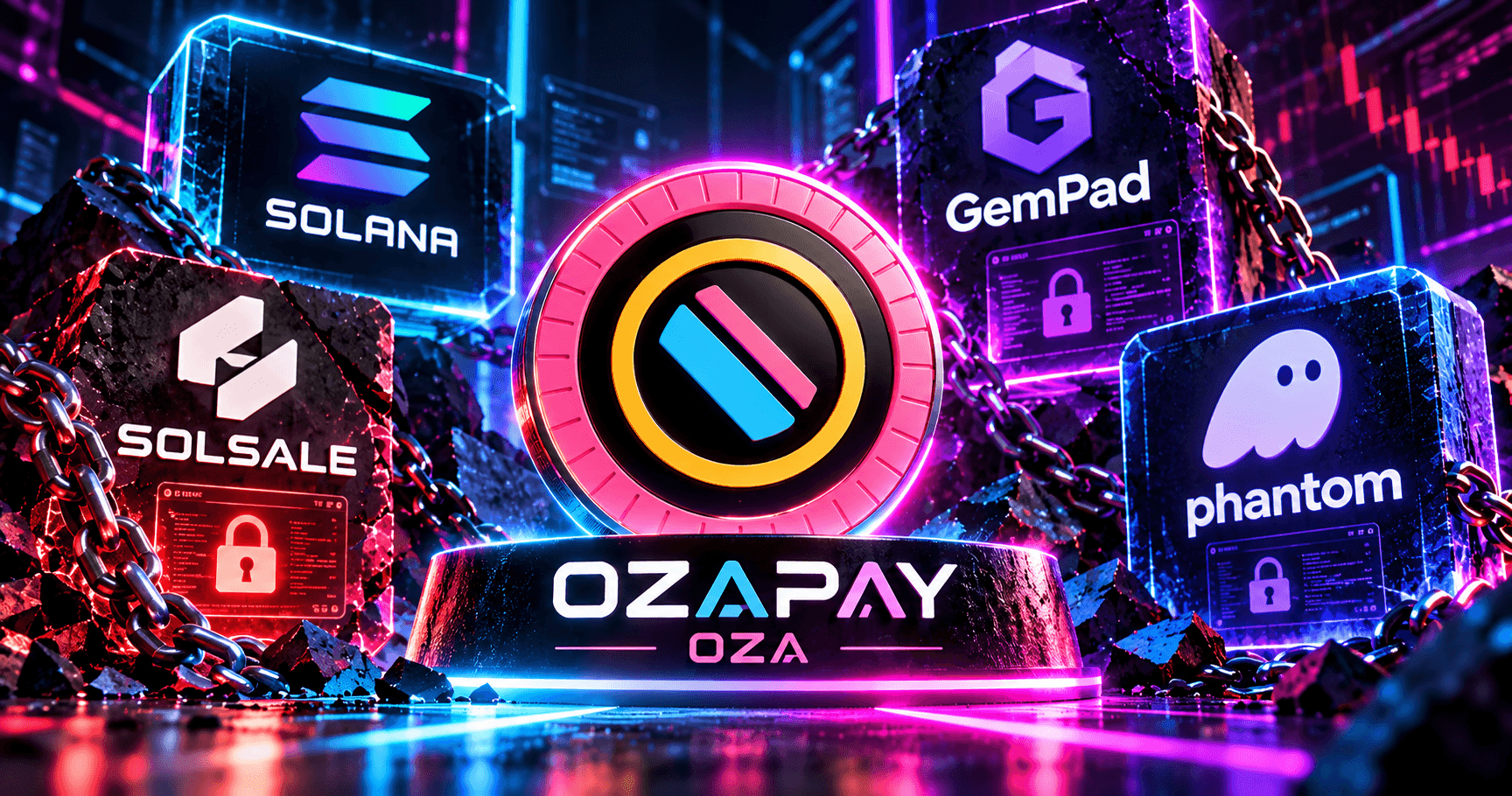
Solsale incident, holder protection, OZA V2 launch and outlook: why our ambition remains intact despite the events of October 29, 2026.
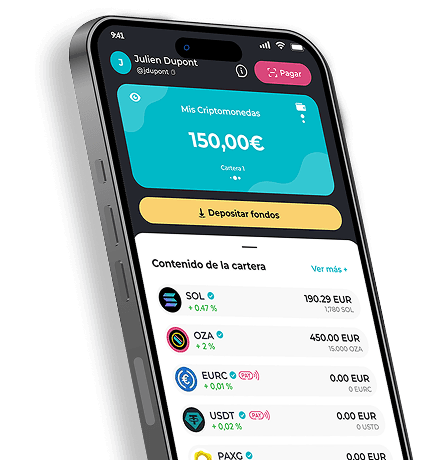
JOIN
OZAPAY
AND GET €5 IN OZA!
The crypto app made for you
Use this code when you sign up
OZABRAAlready registered?Log in

Your money, your rules.
Pay, send and receive in full freedom.

Disclaimer: Buying and holding OZA tokens involves a risk of partial or total loss of the invested capital. OZA is neither a financial instrument, nor a bank deposit, nor a regulated savings product. Crypto-assets are volatile and not covered by legal guarantees, so it is recommended to invest only amounts you are prepared to lose and, if needed, consult a financial advisor before any decision. Access to OZA may be subject to legal restrictions depending on your country of residence. The OZA token is not offered to the public in France within the meaning of Regulation (EU) 2023/1114. Token address: BNpRagRShfkNd9hg3QRDWuJADH7j187jViNTnHMvhWL5. This site does not constitute a public offer of crypto-assets. No AMF visa has been requested or obtained.
© All rights reserved to Ozapay - The payment Super App

0 comments
Log in to comment
Loading…