While everyone is watching artificial intelligence...
For nearly two years, artificial intelligence has captured most of the media attention. Every week brings its share of announcements, new models, and spectacular demonstrations, giving the impression that the next great digital revolution will be summed up by AI.
Yet another transformation is already underway. More discreet, but probably just as profound, it is gradually redefining the way hundreds of millions of people will interact with digital services on a daily basis.
The launch of X Money perfectly illustrates this evolution.
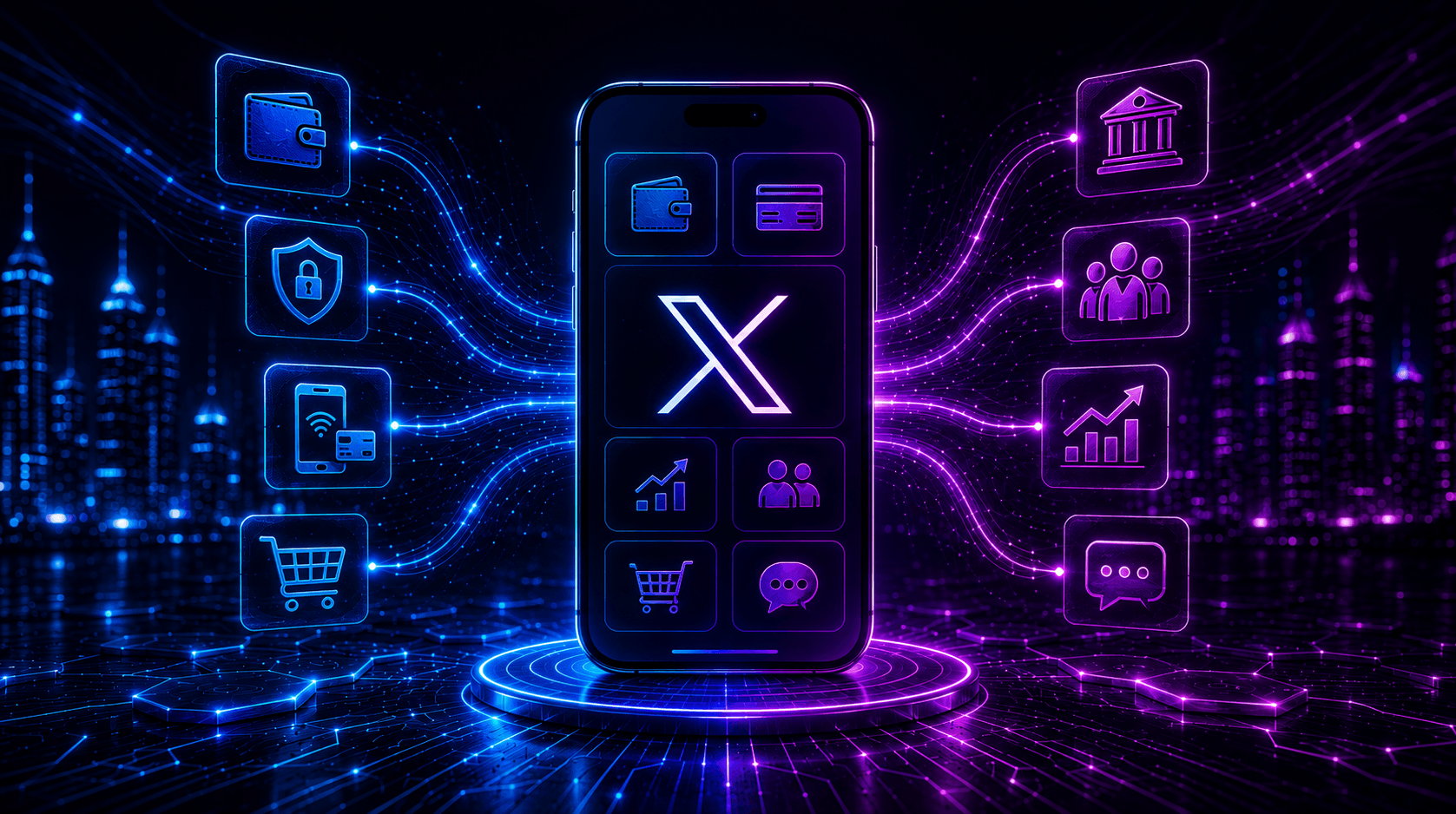
By integrating a digital wallet, instant payments, a Visa card, and, soon, many other financial services directly within X, Elon Musk is not simply trying to enrich his social network. He is pursuing a much more ambitious strategy: turning X into a true Everything App, capable of accompanying the user in an ever-growing share of their digital life.
This announcement goes far beyond the payments sector. It confirms that the next global battle will no longer be solely about the power of artificial intelligence models, but about the ability to build the platforms that will become the main entry point of our daily lives.
Super-apps are not a trend. They are becoming a new digital infrastructure.
A super-app is often reduced to an application grouping several features. This definition is nonetheless incomplete.
A true super-app is not about stacking services. It relies on an integration logic where each feature reinforces the others. The wallet facilitates payments, payments enrich exchanges, exchanges open access to new services, which in turn reinforce the overall usefulness of the platform.
It is this ability to create permanent interactions between different uses that gradually transforms an application into a true ecosystem. The more actions a user performs within a single interface, the more relevant the platform becomes, the more it generates new uses, and the more it creates value for all its partners.
Ultimately, the super-app stops being a simple piece of software. It becomes a digital infrastructure, on par with an operating system, a search engine, or a social network.
It is precisely this evolution that explains why the largest technology groups are now investing massively in this model.
A new global race is underway
China demonstrated the potential of this approach very early on with WeChat and Alipay. The United States is now accelerating with players such as X, Apple, Google, and the major fintechs, each looking to become the preferred interface between users and their financial services.
The goal is no longer just to offer a high-performing application. It is to become the platform the user opens several times a day, the one that naturally concentrates their payments, exchanges, digital identity, investments, tomorrow their artificial intelligence, and, progressively, a multitude of everyday services.
This battle goes far beyond the financial sector. It concerns the way the digital economy of the next decade will be organized.
Europe still has a window of opportunity
For a long time, Europe often joined the great digital revolutions after they had already started. Search engines, social networks, smartphones, and major e-commerce platforms have been largely dominated by American or Asian players.
The current situation is different.
The European market now benefits from a more mature regulatory environment, a particularly dynamic fintech ecosystem, globally recognized talent, and a growing awareness around the challenges of digital sovereignty.
Above all, no European player has yet established itself as the reference for future super-apps.
In other words, the game is not over before it has even begun.
This window of opportunity still exists. But it will not remain open indefinitely.
Digital sovereignty will no longer be decided solely in infrastructure
For several years, Europe has been investing massively in cloud computing, semiconductors, data centers, and communication infrastructure. These investments are essential.
But they are no longer enough.
The applications that will tomorrow concentrate our payments, our digital identity, our exchanges, our investments, and a growing share of our daily uses will themselves become strategic infrastructure.
Whoever controls these interfaces controls an essential part of digital value creation.
Building European alternatives is therefore no longer solely a question of entrepreneurial ambition. It is also an economic, technological, and strategic challenge for the continent.
Our conviction at OZAPAY
Since the creation of OZAPAY, we have shared a simple conviction: the applications of tomorrow will not be those that offer the most features, but those that will know how to make them work intelligently together.
It is in this logic that we are developing our platform today.
We are currently working on a completely redesigned navigation experience, designed to simplify every interaction while naturally preparing the next one. The goal is not to add services side by side, but to build a seamless journey where each use fits into a logical continuity.
Our vision rests on a simple principle: thinking of the platform as a gear mechanism.
Each feature is developed to transmit value to the others. The wallet facilitates payments. Payments enrich interactions. Interactions open access to new services. These new services in turn reinforce the usefulness of the wallet and the entire ecosystem.
As the platform evolves, each new gear drives the previous ones and prepares the next ones. The whole becomes more powerful than the sum of its components.
It is this architecture that, in our view, will make the difference between an application offering several services and a true super-app capable of evolving sustainably. Our ambition is to build, from France, a European alternative that places user experience, interoperability, and digital sovereignty at the heart of its development.
Nothing is settled yet
The launch of X Money does not mark the end of the competition.
It marks its true beginning.
For the first time in a long while, Europe still has a real opportunity to take part in building the next generation of digital platforms. The technologies are available, uses are evolving rapidly, and user expectations are changing profoundly.
The players that will succeed will not necessarily be those that launch the most features. They will be those that build the most coherent, useful, and easy-to-use ecosystems.
At OZAPAY, we believe that this new generation of applications will not look like a catalog of services, but like a perfectly synchronized mechanism, where each innovation will reinforce the previous ones. This is the vision we develop every day, with the conviction that the next great European super-app has yet to be invented.
And it is precisely for this reason that nothing is settled yet.