
OZAPAY & OZA: one application, a whole ecosystem
OZAPAY is the application, OZA is the token of its ecosystem. Do you need to own OZA to use OZAPAY? No. Discover how to use the app, earn OZA, and, if you wish, follow its price or buy some.
Read more


October 19, 2026 — Economy, innovation, and digital sovereignty
As the United States organizes its dominance over digital finance, China develops its own monetary infrastructures, and Russia explores new settlement channels, France is considering taxing cryptocurrency-to-stablecoin conversions.
A decision whose consequences could far exceed the expected tax revenues.
And a vote that raises a fundamental question: does France want to become a major player in Web 3.0, or remain dependent on infrastructures developed abroad?
From an economic standpoint, at first glance, this measure may seem appealing.
With a considerable public debt, persistent deficits, and finances under pressure, seeking new tax revenues appears legitimate.
Why not tax capital gains realized on cryptocurrencies when they are converted into stablecoins? Why maintain a tax deferral on certain transactions when the State must finance its public services?
On paper, the reasoning can be defended.
But an economic policy should not only be measured by what it brings in tomorrow morning. It must also be evaluated through the wealth it will, or will not, help create in ten years.
How much would this tax actually bring in?
How much could it indirectly cost in abandoned investments, companies relocating abroad, jobs not created, and innovations developed outside of France?
And above all, why introduce an additional constraint on an industry that is still emerging, precisely at a time when the world's great powers are seeking to master the financial infrastructures of tomorrow?
On October 16, 2026, the National Assembly adopted an amendment aimed at making certain conversions of crypto-assets into stablecoins taxable, as part of the 2027 Finance Bill.
The result deserves our attention.
Out of 577 seats in the National Assembly, only 100 representatives took part in the vote.
A single-vote margin.
As highlighted by the Journal du Coin in its article of October 17, this particularly tight adoption is explained notably by a low turnout in the vote.
The article also notes that several amendments proposing a more favorable tax treatment for crypto-assets could not be defended in session, as their authors were absent.
One element nevertheless deserves to be recalled: the government issued an unfavorable opinion on this taxation.
The measure is therefore not final. The vote scheduled for October 20 on the revenue portion of the 2027 budget represents a new step, before the parliamentary process continues.
But this first vote already raises major economic questions.
Source: Journal du Coin — Crypto tax: your stablecoins taxed by 100 representatives out of 577, October 17, 2026.
Let's simply look at our daily lives.
Our search engines, social networks, mobile operating systems, advertising platforms, and a large share of our cloud infrastructures are dominated by American companies.
Google, Apple, Microsoft, Amazon, Meta.
These companies do not merely sell services.
They control infrastructures, capture a significant share of economic value, and help define global technological standards.
Europe has produced fine digital companies. But it has not built as many globally dominant platforms.
Today, a new transformation is underway.
With Web3, it becomes possible to transfer value directly on the Internet, tokenize assets, automate settlements, and develop new financial infrastructures.
Having largely depended on American platforms to exchange information, are we going to depend tomorrow on their infrastructures to exchange value?
This is one of the major economic questions of this decade.
In July 2025, the United States adopted the GENIUS Act, a federal framework designed to regulate payment stablecoins.
This legislation notably provides for reserve, transparency, and compliance requirements.
But its ambition goes beyond user protection.
American authorities explicitly present stablecoins as a way to strengthen the international standing of the dollar and to support demand for U.S. financial assets.
In other words, Washington considers these instruments a strategic infrastructure.
The goal is not only to enable American companies to develop new products.
It is also to reinforce the dollar's influence in the global digital economy.
While the United States structures its industry around this ambition, France is considering a measure likely to make certain uses of stablecoins fiscally less attractive.
The two policies are not directly comparable: one mainly regulates the issuance of stablecoins, the other concerns the taxation of certain conversions.
But their economic orientations deserve to be compared.
The United States seeks to make stablecoins a vehicle for its monetary power. France must ask itself whether its tax policy will support or complicate the development of its own players.
It would be inaccurate to claim that China freely encourages cryptocurrencies.
Beijing maintains a restrictive approach to private crypto-assets, while developing digital payment infrastructures, notably around the digital yuan.
Its objective differs from that of the United States: maintaining substantial state control over monetary channels.
Russia, for its part, is exploring controlled uses of digital assets for certain international settlements, particularly in a context of financial restrictions and sanctions.
These models have their own limitations and risks. They should not be confused with an environment open to private innovation.
But they illustrate a fundamental reality.
The great powers now consider digital monetary infrastructures to be a strategic issue.
Their competition concerns settlement systems, currencies, technologies, standards, and international financial flows.
France cannot examine this transformation solely through the lens of additional tax revenues.
This is a point too often overlooked.
Behind the words Bitcoin, blockchain, stablecoins, and Web3, there are French investors, entrepreneurs, developers, engineers, and companies.
Individuals have committed part of their savings to digital assets.
Entrepreneurs have invested their personal resources to create companies.
Teams have spent several years developing digital wallets, payment solutions, platforms, and protocols.
Private investors are funding companies that sometimes do not yet generate profits, but seek to build the infrastructures of tomorrow.
All these investments carry significant risks. Not all of them will be profitable.
But they contribute to the emergence of an industry.
A tax change affecting conversions into stablecoins could affect some of these investors and alter the way they use digital assets.
The question therefore deserves to be asked: has the potential effect of this measure on the private capital already committed to the French ecosystem been sufficiently assessed?
Let's take a simple example.
An individual invests €30,000 in Bitcoin.
A few years later, their assets are worth €70,000.
They decide to convert their position into USDC to reduce their exposure to volatility.
They do not necessarily wish to withdraw their money to their bank account.
They want to keep their funds within the digital ecosystem, possibly to reinvest them later.
Today, under the general regime applicable to individuals, exchanges between digital assets in principle benefit from a tax deferral.
If the conversion to certain stablecoins were to become taxable, this individual could owe tax on their €40,000 capital gain.
At an illustrative rate of 31.4%, that would represent €12,560 in tax, subject to their tax situation and the final terms of the law.
This scenario is also presented by the Journal du Coin to illustrate the potential impact of the amendment.
This would not mean that the investor would have no liquidity: stablecoins can be converted into euros.
But they could be forced to mobilize part of their capital to settle a tax obligation they had not anticipated at this stage of their strategy.
The possible consequence would be a reduction in their reinvestment capacity.
And when this situation affects a large number of investors, it can have repercussions on liquidity and on the financing of the ecosystem.
The State must fund its spending.
That is obvious.
But any new tax should be subject to a full economic analysis.
How much additional revenue would it generate?
How many taxpayers would be affected?
What behaviors would it change?
What share of transactions would be deferred, abandoned, or carried out under other terms?
And what would be the effects on French companies that depend on these uses?
It is not enough to note that a transaction would become taxable to conclude that tax revenues would increase in the expected proportions.
Taxpayers adapt their behavior, and markets evolve.
This does not prove that this tax would reduce public revenues in the long term.
But it justifies a genuine impact assessment.
A tax policy should not be judged solely on its theoretical yield, but on its overall economic effect.
A French Web3 company is not only competing with companies in its department or its country.
It operates in a global market.
Its competitors may be based in the United States, Singapore, Switzerland, or other European countries.
Tax differences alone do not determine where a company sets up.
But they influence the attractiveness of markets, investment decisions, and the experience offered to users.
A French company could thus develop a high-performing technology while finding it harder to get it adopted by certain domestic users.
It would be paradoxical to publicly support innovation while creating additional constraints on some of its fundamental uses.
Stablecoins are not only used to buy and sell cryptocurrencies.
They can facilitate international settlements, fund transfers, and certain automated transactions.
They are also an important component of many decentralized financial applications.
In some models, they could enable merchants and businesses to benefit from new payment channels.
The proposed tax would not automatically tax every stablecoin payment or transfer.
Let's be precise on this point.
On the other hand, if access to these instruments requires conversions that generate taxation, this could complicate certain user journeys.
A payment technology must be easy to understand and use.
The more complex its operation becomes, the more its adoption may encounter obstacles.
Imagine that some French entrepreneurs decide to develop their activities abroad.
Imagine that some investors favor foreign structures or markets with a tax environment deemed more predictable.
Imagine that French talent joins American companies rather than contributing to the development of local ones.
These scenarios are not automatic consequences of the amendment.
But they represent economic risks to be examined.
A company that develops abroad can create jobs there, invest its profits there, and concentrate its intellectual property there.
The technologies will continue to exist.
Users will continue to use digital infrastructures.
The question will be where value creation is located.
If we do not sufficiently build our own players, we risk becoming essentially the customers of infrastructures developed by others.
That is already part of the history of Web 2.0.
Blockchain will not wait for all countries to have found the ideal tax regime.
Companies will continue to innovate.
Investors will continue to fund projects.
Payment infrastructures will evolve.
Tokenization will progress in the sectors where it delivers genuine economic value.
Stablecoins will continue to be experimented with and developed, under very different regulatory frameworks.
France has recognized expertise and an entrepreneurial ecosystem capable of participating in this evolution.
It also benefits from the European MiCA framework, which can help strengthen legal certainty in the sector.
But regulation and taxation must work together coherently.
The challenge is not to eliminate all taxation of crypto-asset gains.
The challenge is to determine when tax should become due, on which transactions, and with what consequences for users and businesses.
Because if Web 2.0 was largely dominated by the United States, nothing obliges Europe to reproduce that scenario with Web 3.0.
It is still necessary to give it the means to develop its own companies.
We can understand the desire to seek additional tax revenues.
We can understand the objective of treating different categories of capital gains fairly.
We can also understand the need to combat abuses.
But these objectives do not exempt us from assessing the economic consequences of a measure.
France does not only lack tax revenues.
It also needs growth, private capital, technology companies, skilled jobs, and infrastructures capable of competing with those of the great powers.
And to these economic issues is added an often underestimated problem: the genuine tax headache that this reform could create.
Today, the taxation of crypto-assets is already particularly complex for many individuals.
They have to track their acquisitions, taxable disposals, the overall value of their portfolio, capital gains and losses, transaction supporting documents, and any reporting obligations related to foreign accounts.
With this new measure, conversions into certain stablecoins could themselves become taxable events.
Imagine an investor who carries out several tens, or even several hundred, transactions per year.
They buy Bitcoin, exchange it for Ethereum, convert part of their assets into USDC, reinvest, then temporarily return to stablecoins.
Tomorrow, some of these conversions could trigger additional tax obligations.
They would then have to precisely identify the transactions concerned, determine the values to be used, calculate taxable gains according to the applicable rules, and keep all supporting documents.
All of this in an environment where assets can move between multiple platforms, wallets, and decentralized protocols.
For individuals, this could mean more complex filings, greater risk of errors, and higher accounting support costs.
For accounting professionals, more verifications and transaction reconciliations.
And for the tax administration itself, new transactions to audit, sometimes in particularly complex technical environments.
An additional economic question then arises: what will the actual cost of managing this new taxation be, both for taxpayers and for the administration?
These compliance and control costs would need to be assessed against the expected tax revenues.
Because a tax does not automatically become effective just because it widens the tax base.
It must also remain understandable, enforceable, and proportionate.
Web3 is not a guarantee of prosperity. It is an emerging industry, with its risks, its failures, and its opportunities.
But precisely because its future remains to be built, the decisions taken today can have significant consequences.
The October 20 vote will not necessarily close the legislative debate.
It should nevertheless be an opportunity for broader reflection on the place France wishes to occupy in the global digital economy.
We have already seen a large share of Web 2.0 value concentrated in the United States.
Are we going to create the conditions to participate in building Web 3.0, or risk watching a new generation of global companies develop elsewhere?
This question deserves more than a purely budgetary answer.
Because the real issue is not only to know how much the State could recover from investments made yesterday.
It is also to know how much wealth, jobs, innovation, and tax revenues France will be able to generate tomorrow.
The global digital economy will continue to move forward. The real question is what place France wishes to take in it.
By Johan Decottignies
OZAPAY is the application, OZA is the token of its ecosystem. Do you need to own OZA to use OZAPAY? No. Discover how to use the app, earn OZA, and, if you wish, follow its price or buy some.
Read more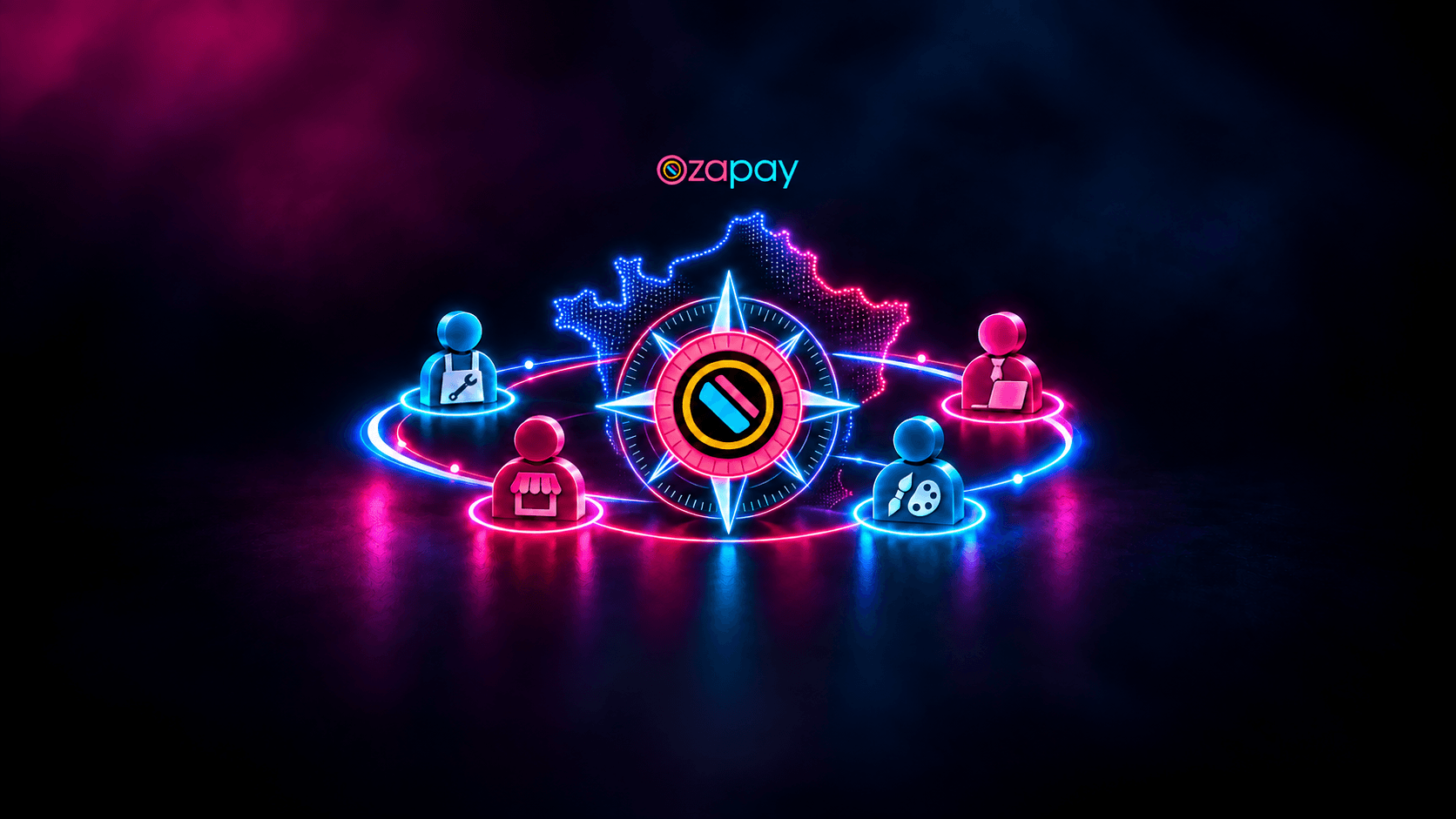
OZAPAY is reshaping the economy around a new compass: a trade and professions explorer built on proximity, trust, and French know-how. Tomorrow, anyone will be able to discover the professionals around them, while entrepreneurs will be able to simply manage their clients and their activity, supported by a smart assistant and AI. A technology designed in France, at the service of a more human economy.
Read more
While Europe is still hesitating over the place of digital assets, other powers are already building the financial infrastructures of tomorrow. Regulate without suffocating, protect without banning, and preserve the freedom to choose: Europe must act before the dominant positions are taken elsewhere.
Read more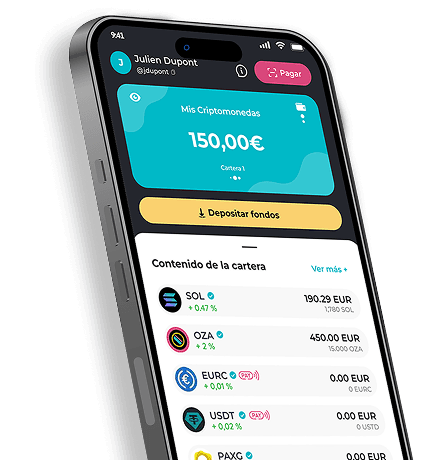
JOIN
OZAPAY
AND GET €5 IN OZA!
The crypto app made for you
Use this code when you sign up
OZABRAAlready registered?Log in

Your money, your rules.
Pay, send and receive in full freedom.


Disclaimer: Buying and holding OZA tokens involves a risk of partial or total loss of the invested capital. Links to Raydium and Coingecko are provided solely to make access to market information and third-party trading tools easier — Ozapay does not manage them and is not responsible for them. OZA is neither a financial instrument, nor a bank deposit, nor a regulated savings product. Crypto-assets are volatile and not covered by legal guarantees, so it is recommended to invest only amounts you are prepared to lose and, if needed, consult a financial advisor before any decision. Access to OZA may be subject to legal restrictions depending on your country of residence. The OZA token is not offered to the public in France within the meaning of Regulation (EU) 2023/1114. Token address: 67iVSrbgQKiPjttU9uXx9CXUoS1Si3XUhrXeiNAUUZSR. This site does not constitute a public offer of crypto-assets. No AMF visa has been requested or obtained.
© All rights reserved to Ozapay - The payment Super App
